



How higher education and institutional owners can plan, phase, and deliver renewable-energy infrastructure without disrupting campus life
Campus and building decarbonization has shifted from a long-term aspiration to an active driver of capital planning initiatives. Institutions are setting carbon-neutral goals and timelines in response to climate change as well as evolving codes and policy, and modernizing aging central plants and distribution networks. The result is a growing number of campus-wide projects that replace fossil-fuel systems with all-electric solutions and smarter demand management.
These initiatives are more than building-system upgrades. Campus decarbonization is a site and infrastructure transformation – one that must be planned around tight sites, complex utilities, academic calendars, and continuous operations. In this article, we’re sharing a practical overview of the value, typical approach, and what it takes to deliver these projects successfully.
What is campus/site decarbonization?
“Decarbonization” typically means replacing fossil-fuel heating (typically natural gas or steam distribution systems) with all-electric heating and cooling, then supplying that electricity with greener sources over time. This can be done at the campus scale to upgrade the district energy system or for individual buildings through retrofit projects or new construction. The specific solution set varies by project, based on phasing, budget, site/capacity constraints, construction impacts, regulatory requirements, and more. The solution often includes a combination of:
- Electrification of central plants and building systems: Converting boilers and other fossil-fuel equipment to electric alternatives using heat pumps and low-temperature hot water systems. These greener electric alternatives can be fed by thermal reservoirs, geothermal well fields, heat recovery systems, waste to energy plat, solar photovoltaics (PV), wind power, and more.
- Load reduction and efficiency: Lowering demand through envelope improvements, lighting/controls upgrades, and right-sizing utilities and distribution.
- Energy storage and resiliency measures: Where applicable, battery storage and associated safety-driven siting requirements.

Nitsch is providing land surveying, civil engineering, and site structural engineering services for the Salem State University Bold: Decarbonization Project, in support of the University’s goal to break free of fossil fuels by 2050. We have supported the design-build project from master planning through construction documents for campus site improvements and utility routing.
Why decarbonize campuses now?
Multiple forces are accelerating the shift from long term climate goals to near term action, making campus decarbonization a priority for institutions today. This includes:
- Institutional climate commitments: Many universities and institutions have published carbon neutrality targets that require action across existing buildings (not just new construction).
- Policy and code trends: Public owners may be driven by executive orders or agency requirements; municipalities increasingly limit fossil fuels in new buildings. For example, Massachusetts is working towards Net Zero greenhouse gas (GHG) emissions by 2050, with an interim goal of reducing carbon pollution to 50% below 1990 levels by 2030. As part of that roadmap, state-owned facilities (such as public colleges and universities, state office buildings, courthouses, State Park visitor centers, and more) are working to decarbonize their buildings and sites.
- Energy cost and resilience: Electrification paired with high-efficiency systems can reduce long-term operating and maintenance costs and exposure to fuel-price volatility, while improving reliability with modern controls.
- Campus experience: When planned well, these projects can deliver safer, quieter, and more maintainable systems with fewer onsite combustion risks.
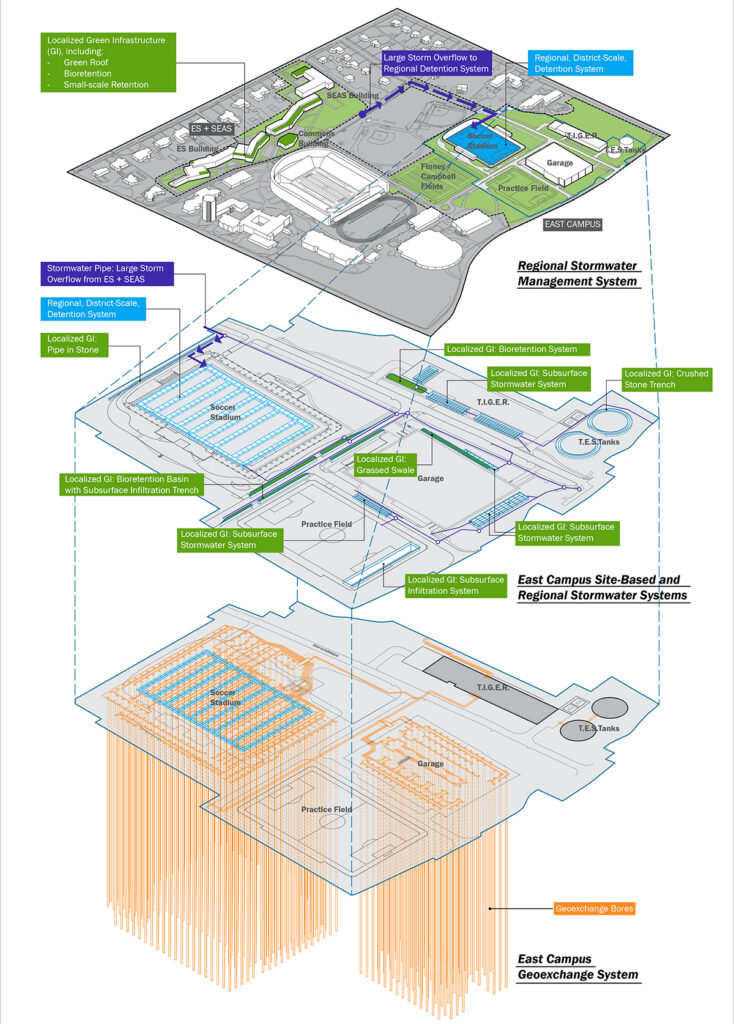
Nitsch performed a district-scale stormwater planning study for Princeton’s 22-acre East Campus. The project included co-locating a regional stormwater management system with a large-scale geo-exchange system as part of the construction of a new Soccer Stadium. This innovative and complex design approach required an intensely collaborative process between Nitsch and the geothermal and M/E/P engineers – resulting in a system that serves as a model for optimizing open space and leveraging redevelopment opportunities to meet aggressive resilience and net zero goals.
What role does civil engineering play in campus/site decarbonization?
Campus decarbonization projects succeed or fail on collaboration: where new infrastructure fits, how it is designed, and how the campus continues to function throughout construction. Our role as civil/site engineers is to integrate buildable infrastructure within highly developed and active campuses. We do this through holistic planning and due diligence, implementable permitting approaches, development phasing, weighing stakeholder considerations, and balancing long-term maintenance goals. The process includes:
- Collaborating with the design team: Utility infrastructure upgrades are complex projects that weave together a lot of different disciplines: MEP engineering, geothermal design, environmental engineering, landscape architecture, architecture. Having a team member like Nitsch who is known for working collaboratively to find resilient and innovative solutions is critical to project success.
- Site Assessment and Due Diligence: Our engineering experience and direct coordination with Nitsch’s land surveyors establishes the investigation programs required to evaluate underground conditions to minimize future conflicts and streamline design. This may include additional investigations in addition to traditional land surveying approaches, including subsurface utility engineering (SUE) techniques, test pits, and additional record data research.
- Working within limited space above and below ground: Available space (especially on already developed campuses) is at a premium, and finding a way to use that efficiently and effectively requires experience and knowledge. Nitsch has a long history of coordinating with design team professionals to site geothermal fields, utilities, vaults, and conduits within already‑congested corridors, maintaining required separations, avoiding conflicts, and preserving future flexibility through early mapping and iterative design.
- Integrating stormwater and drainage systems: We make sure permanent infrastructure and construction staging do not compromise drainage performance, infiltration systems, or regulatory compliance, recognizing that temporary impacts can be as consequential as permanent ones. We also help our clients look for opportunities to integrate site-, district-, and campus-scale stormwater and resilience opportunities as part of these projects.
- Navigating complex permitting environments: In addition to local site approvals, geothermal systems may trigger review by conservation commissions, boards of health, and other agencies. Nitsch supports permitting with clear documentation and proactive coordination to determine applicable regulatory thresholds and drivers, and ultimately streamline permit reviews.
- Coordinating electrical and energy infrastructure siting: We help integrate PV canopies, interconnection equipment, transformers, and (where used) battery storage alongside architectural, structural, and campus‑planning constraints.
- Planning around continuous campus operations: Nitsch develops phasing and logistics plans that consider maintain existing thermal heating systems for phased upgrades, accessible access routes, emergency services, deliveries, and parking, treating interim conditions as carefully as the final design.
- Designing for constructability and stakeholder protection: Nitsch focuses on solutions that can be built within property limits, fit around existing infrastructure, respect abutters, minimize disruption, and reduce the risk of redesign, delays, and unexpected costs.
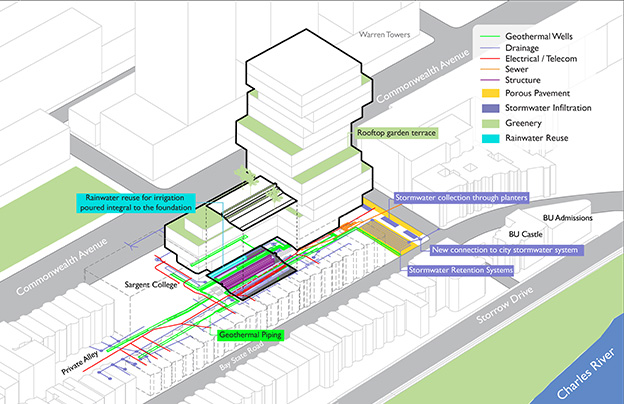
Nitsch provided civil and transportation engineering services on Boston University’s Center for Computing & Data Sciences – a building with zero reliance on fossil fuel that will reach carbon neutrality by 2040. We collaborated closely with the geotechnical engineers to locate the innovative stormwater retention system and stormwater injection wells within the same crowded urban site as a geothermal well grid.
What should you look for in a campus decarbonization partner?
The most effective decarbonization teams combine energy-system expertise with site and infrastructure execution. That means partnering with engineers like Nitsch who can evaluate site specific solutions that plan for constructability, coordinate across disciplines, anticipate permitting and campus-operations constraints, and translate ambitious targets into a phased program that the campus community can live through.

If your institution is evaluating geothermal, electrification, solar PV, or a broader campus decarbonization roadmap, we can help assess feasibility, define a realistic phasing strategy, and deliver the site and utility design needed to implement it! Please reach out to Vice President & Director of Civil Engineering Deborah Danik, PE, LEED AP to have a conversation!
Wondering what the future of campus decarbonization could look like?
While many current decarbonization projects and campus climate commitments focus mainly on reducing operational carbon emissions, long-term net-zero goals increasingly call for addressing whole life carbon – including both embodied and operational emissions. Nitsch’s internal research initiative is actively exploring emerging design techniques including promoting the use of low-embodied carbon materials for site construction, and advancing ecological strategies and natural systems that can store and sequester carbon. You can learn more about low-carbon concrete, one of these materials, here.