
Introduction: Water is Infrastructure
World Water Day, observed annually on March 22nd, is a United Nations observance focused on the importance of freshwater and the urgent work still needed to achieve safe water and sanitation for all. This year’s theme — Water and Gender — highlights that water challenges do not affect everyone equally, and that solutions are stronger and more durable when women and girls are centered in planning, decision making, and implementation.
For communities across the Northeast and Mid-Atlantic, high intensity, short duration storm events that deliver weeks or months of rainfall in just a few hours is a compounding stressor on water supply, quality, and treatment. These storms can quickly overwhelm streets, drainage systems, and public spaces, triggering roadway flooding, eroded construction sites, and overwhelmed catch basin inlets. These effects result in increased pollution runoff to ponds and rivers, and unsafe conditions for people moving through the public realm.
In Massachusetts, the July 10, 2025 storm that impacted South Shore communities including Weymouth, Hingham, and Braintree delivered more than 6 inches of rain in a matter of hours, a rainfall event local meteorologists characterized as a 1 in 200 year, or 99.5th percentile storm. The resulting flash flooding closed highways, inundated neighborhoods, and highlighted how vulnerable communities can be to short duration, high intensity rainfall.
At Nitsch Engineering, we approach water through integrated planning and design. This aligns stormwater management, green infrastructure, transportation, site design, and public realm improvements to deliver measurable, multi-benefit outcomes that perform during both everyday storms and extreme rainfall events.
When rain or snow hits the ground, it can pick up pollutants and flow into storm drains and receiving waters. Green infrastructure strategies such as bioretention, green roofs, and permeable pavement help reduce and treat stormwater closer to where it falls, improving performance and resilience and minimizing surface pollutant runoff and downstream water quality challenges.
We focus our work with a watershed-scale understanding of rainfall. We work to identify opportunities for reducing runoff volume and slowing peak flows. This decreases the risk of localized flooding and eases pressure on closed drainage systems. Additionally, runoff from paved surfaces can transport sediments, oils, nutrients, microplastics, and deicing materials into nearby ecosystems. Practices that filter and treat stormwater can reduce pollutant loading and protect waterways.
Green infrastructure can simultaneously support stormwater management and deliver additional benefits including shade, greener streets, and stronger place-making when paired with transportation and streetscape upgrades. Nitsch’s 2026 research initiative, Quantifying the Co-benefits of Green Infrastructure, is focused on quantifying these co-benefits.
World Water Day 2026 reminds us that water and sanitation are deeply linked to equity and opportunity and that inclusive processes and community-centered design are crucial to project and community success. In practice, that means prioritizing interventions where risk and burden are highest, and designing public spaces and systems that both support visitors with programming as well as store and help manage flood waters.
Project Spotlights
Spotlight 1: Green Infrastructure Integrated into Streetscapes, at a Watershed Scale
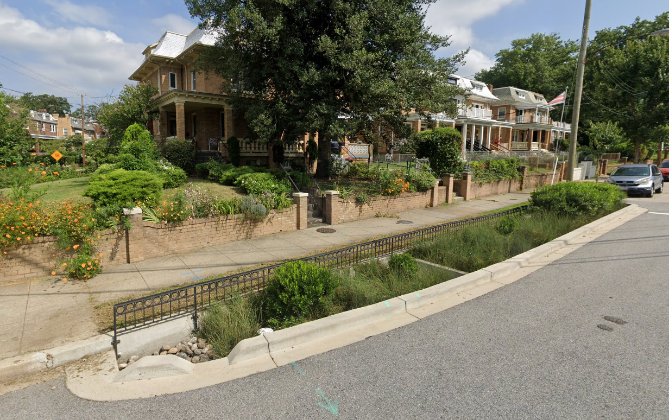
In Washington, D.C., streetscape improvements along Kennedy Street demonstrate how bioretention curb extensions and permeable pavers can be incorporated within the public right-of-way to better manage stormwater while improving the corridor experience.
Kennedy Street achieves multi-benefits, and utilizing a similar approach can help communities get more value out of each capital project addressing runoff and streetscape improvement goals together. The constructed Kennedy Street block captures ~60,000 gallons of stormwater, retains full runoff from a ~2.1-inch storm event, and removed ~9,000 square feet of impervious area.
The Rock Creek Green Infrastructure Project A expansion context is actually where Kennedy Street becomes much more than a one-block demo, and it created a watershed-scale GI program. Approximately 21 acres of impervious surfaces are managed using green infrastructure techniques across 36 bioretention planters, and 39 permeable parking lanes and alleys. These installations have contributed to a modeled 90% reduction in Combined Sewer Overflows (CSO) to Rock Creek, and a 20% reduction in runoff volume over five years.
Spotlight 2: Curb Extensions that Support Safety and Stormwater Performance
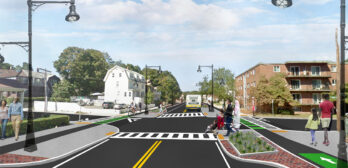
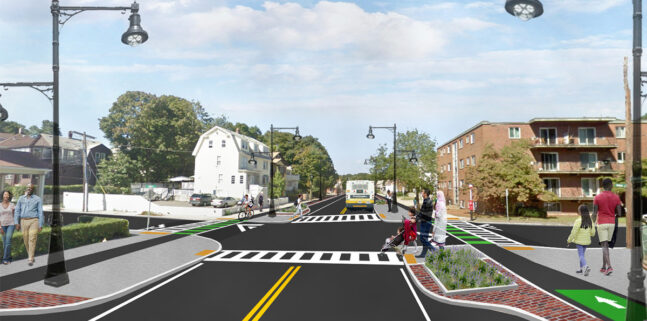
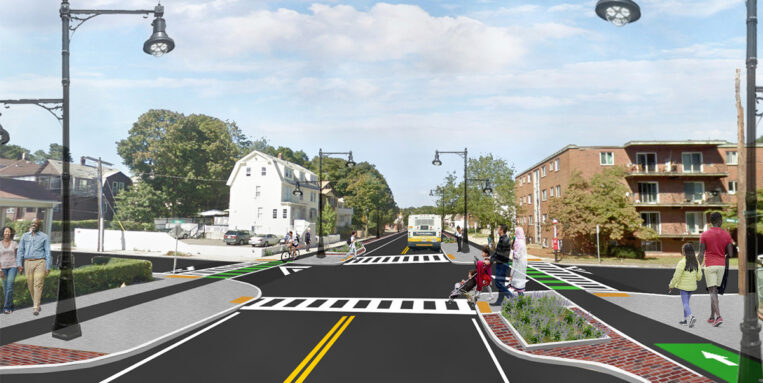
In the Mattapan neighborhood of Boston, Nitsch has been leading the design of several green infrastructure installations in recent years, specifically at New England Avenue and along Cummins Highway. Bioretention planters located within curb extensions can filter and absorb stormwater while also shortening crossings, improving visibility, and enhancing the pedestrian environment.
World Water Day is a useful reminder that water is not only a resource — it’s a foundation for public health, environmental quality, and opportunity. The 2026 theme, Water and Gender, underscores that durable water solutions depend on inclusive leadership and community-centered decision-making.
When communities invest in water-smart planning and design especially strategies that reduce and treat stormwater where it falls, we can protect waterways, improve resilience, and build greener, more welcoming public spaces.

Inspiring the Next Generation: Introduce a Girl to Engineering Day
At Nitsch, advancing gender equity isn’t limited to the projects we deliver — it also includes how we help grow the pipeline of future engineers. Each year, we host Introduce a Girl to Engineering Day, welcoming students to explore what engineers do through hands-on activities, conversations with staff, and real-world examples of problem-solving that strengthen and improve communities. In a field that shapes essential systems like drinking water, stormwater, and flood resilience, ensuring that girls and young women can see themselves in engineering is one way we support the World Water Day theme of Water and Gender: better outcomes happen when more perspectives are represented in the work.
What’s Next?
If you’re planning upcoming roadway, park, campus, or redevelopment work, we’d love to help you find the “water opportunity” inside that project — and turn it into measurable benefits for people and ecosystems. As a women-led firm, Nitsch Engineering is committed to advancing gender equity in the engineering field, and we believe resilient water infrastructure is stronger when diverse voices help shape priorities, design decisions, and long-term stewardship. To continue the conversation, reach out to one of our team members Jessica Wala, PE, ENV SP, LEED AP ND, Brittney Ferber, PE, CFM, Chanel Jackson, PE, MPH, Nicole Holmes, PE, LEED AP, or Kelsey Kern, PE, LEED AP for more information and to explore how we can support your next project.